
meet our new Chief Operating Officer, Ludo Bonnet
May, 2026
In an industry often defined by compliance and incremental progress, Ludovic “Ludo” Bonnet has built a career on moving with both precision and pace. A senior biotechnology leader with more than two decades experience in the pharmaceutical industry, Bonnet combines a deep understanding of science and engineering with a natural intuition for commercial strategy and system efficiencies moving seamlessly between each.
His path into the industry was, by his own account, less a leap than a natural progression. Raised in a household where science was part of everyday conversation – his father a physicist whose work, he jokes, he never fully understood – Bonnet’s curiosity was sparked early. A childhood chemistry set became the first step in a lifelong fascination with how things work, and more importantly, why.
That curiosity carried Bonnet through academia and into industry, where his early career quickly set the tone for what followed. Entrusted with leading a product from development through to market, he worked on the first generic pressurised metered-dose inhaler (pMDI) programme to secure licence approval in Europe via an in vitro equivalence-only pathway. Built on exceptionally strong data, the program bypassed the traditional route to translation – an unconventional achievement that cemented his appetite for translating rigorous science into tangible, real-world outcomes.
“It showed me what’s possible when the science is truly compelling,” he has reflected. “But it also taught me that moments like that are the exception, not the rule.”
As Director of Inhalation Product Development at Circassia, Bonnet oversaw the strategy and execution of the company’s respiratory portfolio, with responsibility spanning budget management, programme planning and senior leadership reporting. He played a central role in shaping pipeline strategy and optimising development timelines to balance speed with cost and control, while coordinating large, cross-functional teams through a structured project management approach. In parallel, he managed key external suppliers and licensing partners, led a team of product development and technical specialists, and served as the internal authority on CMC (Chemistry, Manufacturing and Controls), quality frameworks and the negotiation of complex service and supply agreements with third parties.
That early experience shaped Bonnet’s enduring philosophy: great science is only part of the equation. Execution – disciplined, strategic and aligned with regulatory realities – is what ultimately determines success.
Over the years, Bonnet has become known for his ability to lead complex combination product development programs that not only stand up to regulatory scrutiny but accelerate time-to-market. His approach is grounded in a simple but often overlooked principle: engage early, and stay engaged.
At Enesi Pharma Limited, Bonnet served as VP Product Development and co-Director before continuing as a Senior Retained Consultant, playing a central role in setting up the company’s R&D capabilities. He built and led a multidisciplinary team of more than 25 scientists and engineers, while working closely with the CEO and CFO to define objectives, manage budgets and report to the board. Under his leadership, more than 30 vaccine development programmes – across human and animal health – progressed from concept to in vivo validation. He also oversaw development of a novel drug-device platform, from design and human factors through to engineering validation and design freeze, while leading regulatory strategy and engagement with agencies including the FDA, MHRA and WHO. In parallel, Bonnet drove process optimisation and manufacturing strategy, secured US $3.5 million in grant funding, supported patent development, and maintained oversight of quality and safety systems – reflecting a remit that bridged innovation, execution and commercial readiness.
In an industry where innovators can sometimes view regulators as obstacles, Bonnet sees them differently – as critical stakeholders in the process of bringing therapies to patients.
“There’s a misconception that regulators slow innovation,” he has said. “In reality, they’re primed to help – if you bring them in early, genuinely listen and work in partnership.”
It’s a perspective born from experience. Bonnet has seen promising programs falter not because the science failed, but because teams assumed it would “just work” and neglected the groundwork required to validate their approach in the eyes of regulators.
“The business of drug development is double-edged. The drive to push boundaries must be matched by an equally strong commitment to feasibility,” he notes.
“You can run very fast toward innovation, but if you don’t consider how it scales, or whether it’s clinically and commercially viable, and how that’s all documented, you risk building something that can’t survive beyond the lab.”
It’s this ability to bridge ambition with execution that has made Bonnet a sought-after leader, particularly in environments where multidisciplinary alignment is critical. Colleagues describe a leadership style that is both rigorous and enabling – focused on outcomes, but equally invested in developing the people who deliver them.
A significant part of that investment is directed toward early-career researchers. Bonnet has a particular affinity for what he calls “crazy ideas” – the kind of bold, unconventional thinking that can redefine fields but often struggles to gain traction.
“There’s no shortage of brilliant ideas,” he says. “What’s often missing is the pathway – how to structure them, how to pitch them, how to make them real.”
Through mentorship and advisory roles, he has helped researchers and founders translate those ideas into viable programs and products. His work spans continents, with ongoing consultancy engagements ranging from RNA vaccine ventures to emerging biotech companies in Europe and Australia.
Australia, in particular, has become an important chapter in Bonnet’s story. After years in the UK, he relocated with his family, describing the move as both a professional opportunity and a personal return to a lifestyle closer to his roots. A self-described fisherman at heart, Bonnet grew up around the water, and the rhythm of that environment still informs his perspective.
Fishing, after all, is an exercise in patience, timing and adaptability – qualities that translate surprisingly well to drug development.
If there is a unifying thread through Ludo’s career, it is a commitment to impact. Not just advancing pipelines or meeting milestones but ensuring that the science ultimately delivers for patients.
“What keeps it interesting,” he says, “is knowing that good science can genuinely make a difference,” he said.
“You have to stay curious, stay grounded, and never assume that great science alone is enough.”
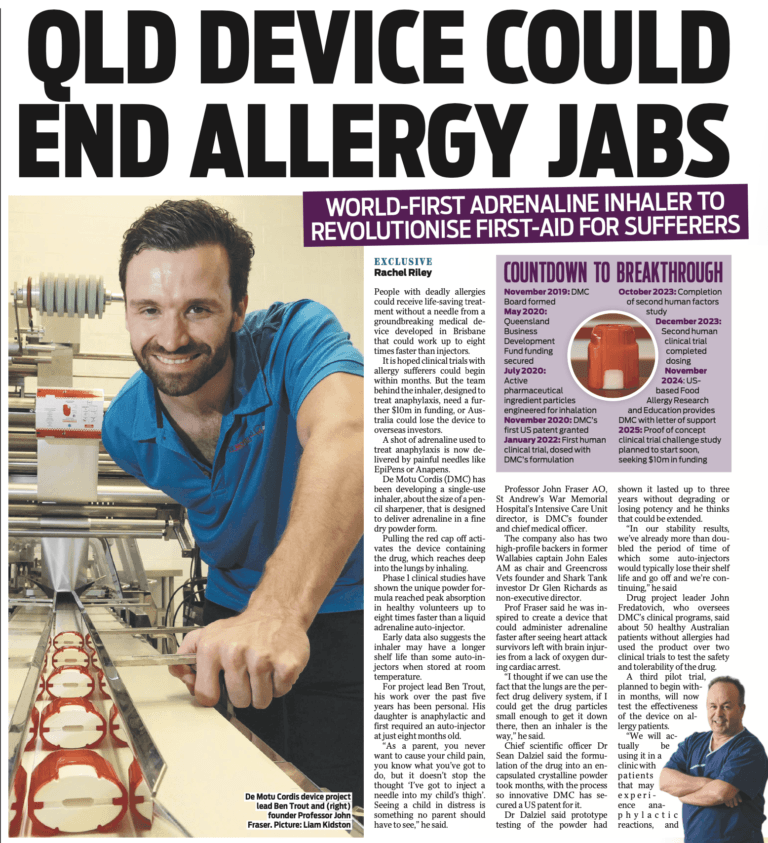
About DMC
“DMC is a clinical stage pharma company.”
DMC was founded in Brisbane, Australia by Professor John Fraser, an Intensivist and groundbreaking clinician, researcher, and company founder. John is also founder of the Critical Care Research Group and is a co-founder of BIVACOR Pty Ltd. John co-founded the COVID-19 Critical Care Consortium that facilitated collecting over 35 million data points from ICU units worldwide and aided in the development of treatment pathways.
Since inception, DMC has raised over US $21m in Seed rounds primarily in Australia. The majority of funding to date have been secured via the Queensland Business Development Fund, high net worth individuals and Australian family offices. A Series A financing round is planned for H2 2025, which will ideally be anchored by a US based VC.

Meet our new Chief Operating Officer, Ludo Bonnet
With more than two decades in pharmaceutical development, Ludovic Bonnet has built a career turning rigorous science into real-world outcomes – from leading Europe’s first generic pMDI approval via in vitro equivalence to advancing over 30 vaccine programmes from concept to validation.
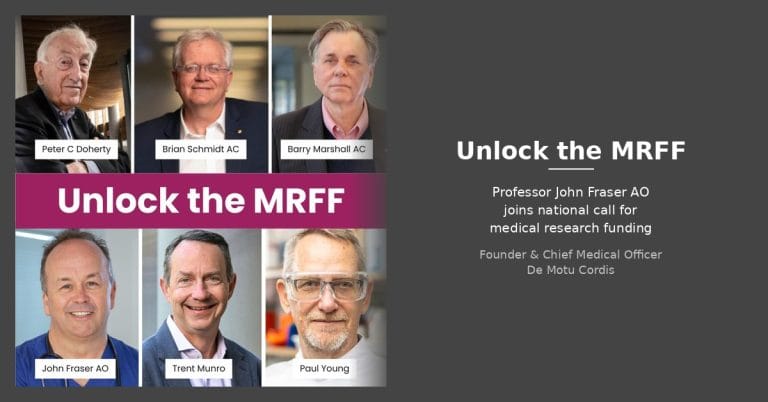
Unlock the MRFF – Professor John Fraser AO Joins Call for Action on Medical Research Funding
DMC Founder Professor John Fraser AO is among more than 60 leading scientists and three Nobel Laureates calling on the Australian Government to unlock the Medical Research Future Fund.

Redefining What’s Possible in Emergency Drug Delivery
At the demanding intersection where innovation meets commercial reality, DMC’s Legal Counsel, Sonia Barber stands out as a leader who speaks fluently across law, business, science and global strategy.